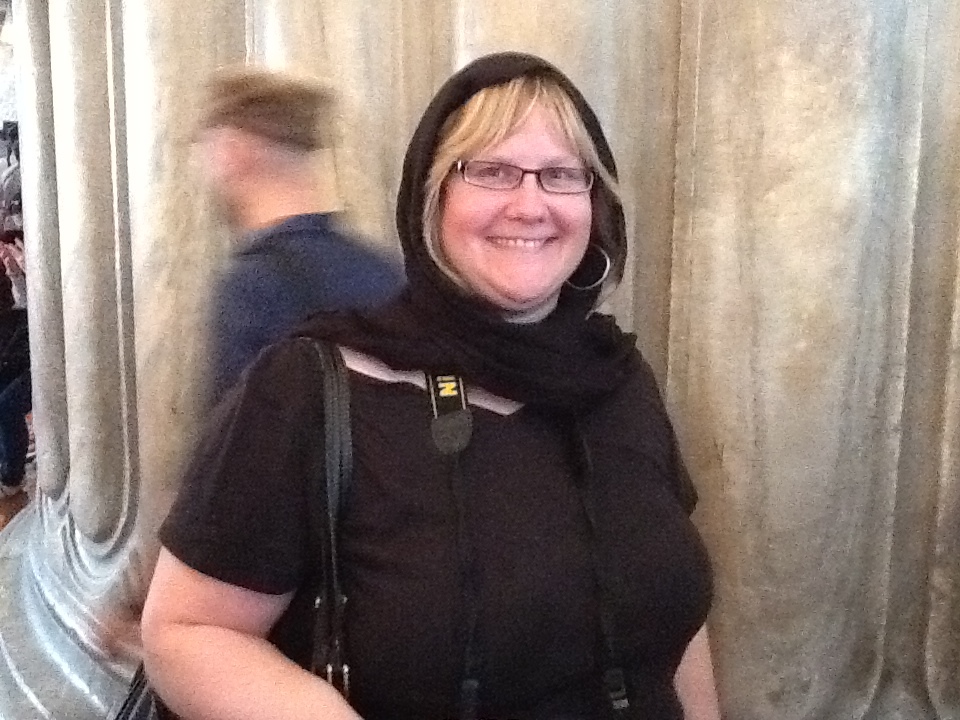
It was another full day in Istanbul. We started our actual tour with our group today, and were fortunate to have only 6 others people with us. They are all Canadian. Our tour guide Seznig, is from Turkey and did a nice job.
First we went to the Hippodrome.The Hippodrome was the sporting and social centre of Constantinople, capital of the Byzantine Empire. Today it is a square named Sultanahmet Meydanı, with only a few fragments of the original structure surviving. It is sometimes also called Atmeydanı (Horse Square) in Turkish because there were chariot and horse races. It was hard to picture a 100,000 seat complex because the stadium seats were used in the construction of the palaces and neighboring buildings on the square. There’s an Egyptian obelisk with hieroglyphics in the middle of he square. One of the emperors purchased it in 359 AD to put in the hippodrome.
The funny part about our adventure today was that when we arrived at the hippodrome, it looked very familiar. That was because last night, coming home from and tired after the spice bizarre we walked through the square never realizing it was the hippodrome.
The Ottoman Turks, who captured the city in 1453 and made it the capital of the Ottoman Empire, were not interested in racing and the Hippodrome was gradually forgotten, although the site was never actually built over.
Maybe more history than you wanted, but it’s like Rome…you can’t walk the streets of Istanbul without seeing the history of this magnificent city all around you.
Our next stop was Hagia Sophia also called St Sophia or Ayasophya. This was at one point the largest church in the world. It was open as a Greek cathedral in 360 AD, then was a mosque from 1453 until 1931, when it was secularized. It was opened as a museum in 1935. Sophia in Greek means “Shrine of the Holy Wisdom of God.”
Many of the Christian items were removed but as the building is being restored so are the mosaics of Jesus and the Mother Mary.There are Islamic features such as the mihrab, minbar, and four minarets. It’s really quite beautiful.
After St Sophia, we found a cute cafe on a side street for lunch. The pita in Istanbul is incredible and kindof looks like a huge woopie cushion when it arrives at your table. You have to deflate it and pull it apart to eat it. Mom had lamhmacum which was like a very thin crust pizza with spices and meat. You’re given lettuce, carrots, peppers and lemon to put on top of it. Yummy. I had a pita with braised beef and cheese…kindof like a stromboli but much better.
Next was the Museum of Islamic Arts. The tickets we purchased for these tours are beautiful. The museum is in the restored palace of Ibrahim Pasha who was the Grand Vezir for Sultan Suleyman the Magnificent for 15 years starting in 1523. He was strangled because the sultan’s wife, Roxelana, didn’t like him. She was a very powerful Russian woman. Don’t mess with the Russians. The museum was very nice showing rugs, Korans, ceramics, and many other pieces.
After walking through the museum, we found a nice table and chairs to relax and people watch. Mom found a rose water drink for us that was sweet and tasty.
Then Basilica Cistern was recommended by our tour guide and mom’s friend Cagla…definitely worth seeing. Built between 527 and 565 it has 336 columns, 12 rows 28 columns each of Corinthian and Doric style. It has the capacity to store 100.000 tons of water. There were two medusa heads, each at the bottom of a column. One was upside down, and the other on its side. There are several myths about why the are in these unusual positions.
We originally were going out to dinner, but are tired and decided to drink on the terrace. Mom had a glass or two of white wine, but I tried the local Raki. It’s like a shot of sambuca that comes in a tall glass. But then you add water to it, and the chemical reaction turns it cloudy.
Another interesting sound of the city is the call to prayer (ezan). This occurs 5 times a day starting at dawn and the last one occurs when the last light of the day disappears. Prayer times differ, determined to the minute by the position of the sun and the longitude and latitude of the mosque. Which seems very weird since we heard it for the first time around 1:12. It’s amazing to hear how this wave of sound carries. The ezan summons the faithful to the mosque for prayers, but it’s not required that prayer take place in a mosque.
I had to look this up, but the words of the ezan are: God is great, I testify that there is nothing but God, I testify that Muhammad is the prophet of God, come to prayer, come to salvation, God is great, there is nothing but God. The morning ezan has an extra line added: Prayer is better than sleep. Five times a day, at dawn, mid-day, mid-afternoon, sunset and night, the ezan rings out, reminding everyone that they should take time out of their day to remember God and give thanks. It does feel like an integral part of the feeling of Istanbul.
 Traveljunkies
Jacqui,
You’re certainly “packing” everything in. I can’t believe all that you’ve seen since your arrival three days ago. I’m enjoying your blog and look forward to reading it every day.
Loretta
Hi did you notice an arrow on the ceiling in your hotel room? they have these in muslim countries the arrow is always pointing towards Mecca.