We left our hotel this morning at 8, but before leaving we were able to catch the sunrise over the mountains and walk around the fishing village. I wish I’d thought of it, but one man went swimming in the Aegean. It would have been a refreshing way to wake up. From the hotel you could see the island of Lesbos. It’s the second largest island in Greece. Crete is the largest and Rhodes next, but we couldn’t see them.
We left Assos, drove by the temple and statue Aristotle and our first stop was an olive oil museum. Then an ethnographical museum in Tahta near Edremit, the ancient Asclepion Roman medical center in Pergamum, mother Mary’s house and then overnight in Kusadasi.
The olive museum was very cool. It was in a small town Kucukkuyu. It was interesting to see the history and how olive oil is produced, the presses, and the final product (oil, soap, olive paste, olives, etc). But also because its such an important crop for turkey. Which was news to both of us. Olive trees date back in Asia Minor to 4000 BC and didn’t progress east to Italy and Spain until 600 BC. Turkey has 90 million trees second to Spain who has 120 mil. The Goddess Athena created the olive tree, and Athens and was named after her after the olive tree was given as a gift to Greece.
We made our way into the mountains to the ethnographic museum. Turkey used to have many nomads who would live near the sea and then travel into the mountains so their livestock could feed. Nomads practiced shamanism like Native Americans. One tradition that has continued is leaving a ribbon in a holy location to bring good luck. We saw that at Mary’s house later.
The museum was small, but interesting. There was a yurt on display, some wood carving tools, world’s largest turtle, and some beautiful rugs. Lots of weird things like skins, birds, and other stuff. In the village it was interesting to see people in the streets, olive, fig, and pomegranate trees all around.
On our drive to our next destination we chatted with Cathy and Brian from Vancouver, and had quite a view of the various crops grown here such as cotton, corn, sun flowers and miles and miles and miles of olive trees. And then the steel mill, refinery. And cargo hips bringing in the oil.
Next we stopped for lunch in Edremit town center at a restaurant called Cumhuriyet (pronounced Chimma hurri yet, which means republic). Its been around since 1923. Sezgin recommended and it was very good. We noticed on the outside that it was,also recommended in Tripadvisor. I had lamb on a bone that was so tender it fell apart. Mom had chicken that did the same thing. For dessert we had ice cream on top of cheese. Sounds weird, but it was absolutely delicious. I’m not sure how to describe it since it was a texture unlike anything we’ve ever had. Sweet, grainy, and thick like peanut butter but yellow.
After lunch we drove to the famous medical center in Pergamon. Once again another spectacular ruin yet very hot. I think was around 95 in the sun. It was much larger than I expected. The city of Pergamon was an ancient Greek city 16 miles from the Aegean.
When the sick entered the medical center, the first thing they did was walk down a long hall to a courtyard where you can still see a column with the serpent insignia on it.To the left was an alter where you’d make an offering before entering. There was a sign that said death must not enter. It was supposed to be motivating. Then there was a triage place where they would evaluate the persons status, and some would not be allowed to continue. Then the people would go to a spring water fountain and drink from it. It was supposed to have healing properties. Then they walked through a tunnel where there was water running from the spring and psychologists would say positive words through the holes in the tunnel. “You will be well” I think this was my favorite part. After the tunnel they’d enter the center. It was said that in these rooms, patients dreamt and received prognoses through Asclepios, the god of medicine.
There was also a library, that didn’t have any walls because it had burned down, but at one time was the second largest library with 20,000 books.
It was more like a modern spa than a hospital: therapy included mud baths, music concerts, psychotherapy, herbal remedies, dream interpretation and doses of water from the sacred fountain. Some place I’d go. Many of us rinsed our hands in he water, but we’re all a little cautious about drinking anything accept bottled water.
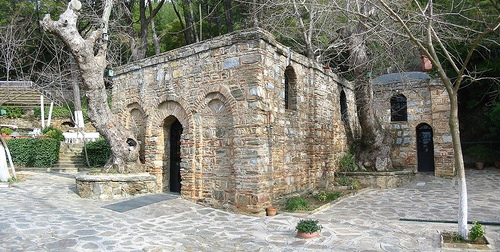
Our last stop for the day was Mother Mary’s house. It was a wonderful time of the day to go. The lines were not long, and the day was cooling down. The house was very quaint and was reconstructed to look like the original. This is supposed to be the house in which she lived the last days of her life. The Roman Catholic Church has never pronounced on the authenticity of the house, for lack of acceptable evidence but nevertheless maintains a steady flow of pilgrimage since its discovery.
Outside the shrine is a particular “wishing wall” which pilgrims have used by tying their personal intentions on paper or fabric. There was also a spring outside the house that some believe is holy water and has miraculous powers of healing. We all wet ourselves just to be on the safe side.
Another full day in Turkey or as the turkish prefer Turkei. Tomorrow Ephesus, rug and leather shopping.
 Traveljunkies
OMG. How do you remember all this detail! Wait, I know the answer to that. Thanks so much for diligently sharing. This is fantastic. That spice picture you need to submit into the EY contest – quite impressive.
Sounds hot; hope you brought your bathing suit.
Loretta