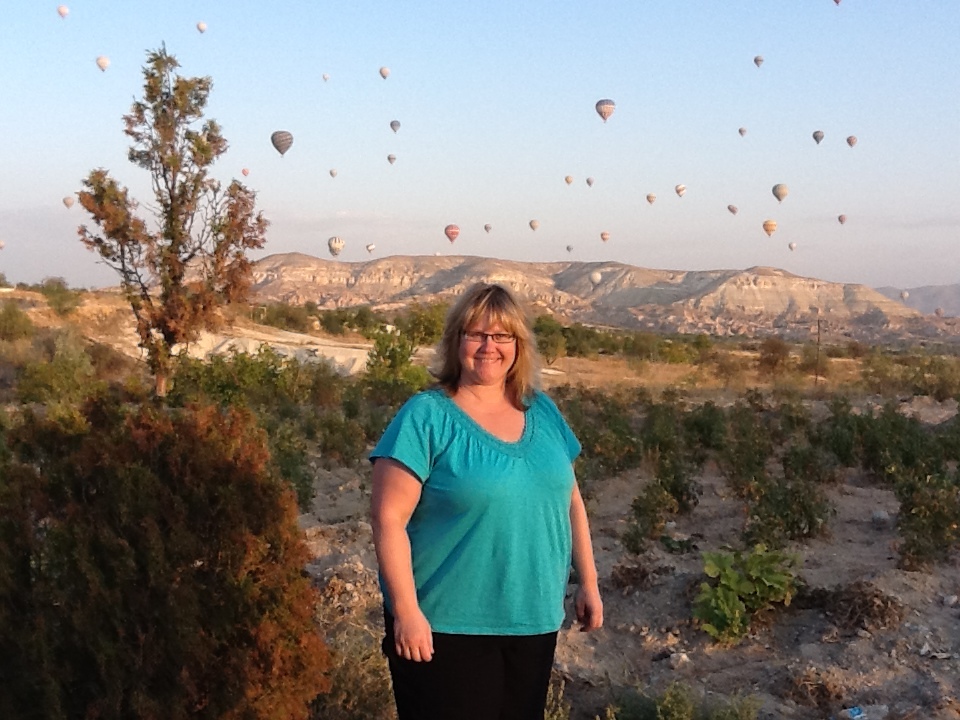
We left our hotel at 7am this morning and arrived at our new hotel in Antalya at 7pm. It was only a 9 hour drive, because we stopped so many places. It was so interesting to see how the landscape changed throughout the drive. From the fairy chimneys, to flat plains, very dry rolling hills, rocky mountains with a few trees, mountains covered with pines, to the small villages to the large city.
The first thing we saw while leaving Cappadocia was all the balloons in the air as the sun was rising. It was so beautiful. We drove through Nevshir, one of the four cities in the Cappadocia province. Then we were on the silk road, used for bringing spices from the far east. Our first stop, Sultanhani, one of the largest caraban used by the men/traders using the silk road as a place to rest. They could stay there for up to 3 nights, and it contained a kitchen, hamam, mosque, courtyard, place for the animals, and sleeping arrangements. They were spaced 30k from each other, which is how long they would travel in a day.
When we hit the road again, we saw so many fields and trucks with sugar beets. Next we stopped by a small cistern, on the side of the road, that’s still being used today to collect water. Seznig looked down into it, and said it was very deep. The next town we went through was Konya. It’s famous for the birthplace of the Sufi religion and whirling dervishes. We drove though the Alps and our highest elevation was 1825 meters (almost 6000 feet). In Turkey they call the mountain region Taurus.
We stopped for lunch in a rest stop and were a little scared at first but the food was good. We had lentil soup, I will admit I liked lentil soup a little, but after this trip I love it…or at least the Turkish lentil. All of the food we’ve had was delicious. I think it’s very close, and may be beating Italian food, as my favorite type of food.
During our bus ride we listened to Turkish music, folk and more modern. I bought one cd, but have a few others I hope to find in Antayla.
As we drove over the mountains, you could see the Mediterranean in the background. Our next stop was the Aspendos theatre. I have to admit I never heard of it before, but OMG. It is the best preserved Roman theatre of the ancient world. It was constructed during the reign of Marcus Aurelius between 160 and 180 AD. It was just as impressive as the colosseum, mostly because it’s in such great condition, and is still used for concerts. It seats about 20,000. I walked up one flight of stairs, but it was very steep. Half way up i wasn’t sure i made the right decision, and crawled the rest of the was. Fortunately, Brian helped me walk down. The height was a little scary.
Next was Perga. In the twelfth century BC, there was a large wave of Greek migration from northern Anatolia to the Mediterranean coast. Many settled in the area immediately east of the area of modern-day Antalya. Four great cities eventually rose to prominence in the area including Perga. It was founded around 1000 BC and some of the structures we visited were the Roman Baths, the Hellenistic towers, and Agora market place. It was very similar to how Ephesus was designed, it was neat to see both Greek and Roman columns.
The Hellenistic city gate dates back to the 3rd century BC. This is certainly the most imposing building of the city and was cleverly designed to protect the city with its twin towers and its horseshoe-shaped courtyard at the back. It is thought that the towers had three floors and were crowned by a conical roof. In the year 121 AD, the horseshoe-shaped courtyard was rededesigned as a courtyard.
After passing through the Hellenistic Gate and courtyard, you enter a broad, marble-paved double-colonnaded street that extends from the main gate to the acropolis. The street is 20 meters wide and is divided in two by a 2 meter wide water channel running down the middle.
I liked the baths. There are three sections. The Caldarium was a very hot and steamy room heated by an underfloor heating system. This was the hottest room in the regular sequence of bathing rooms. after the caldarium, bathers would progress back through the tepidarium, which were used to open the pores of the skin. And lastly to the Frigidarium, where the cold water would close the pores. There would be a small pool of cold water or sometimes a large swimming pool. The water could be also kept cold by using snow.
Our last stop was a jewelry store, that was just too pretentious for us. I tried on a beautiful 4,000 ring in the Ottoman design, but didn’t like it that much. The place was enormous, but a person followed you around. When I asked to see silver, they took us back to a non air conditioned room, and it didn’t look like they even polished any of the jewelry.
We checked into our hotel, and it’s small, but charming. Ate dinner, and went for a quick walk, or we called it a bimble. We’re in the old city and the stone narrow streets are lovely an remind me of Italy.
Off to bed next. Tomorrow is a free day. We’re thinking about a cruise on the turquoise coast, mom wants to go to the archeological museum, and Cathy and I would like to do a hamam,
 Traveljunkies