We woke up this morning to warm, cozy beds in Kakopetria. Decided to go to breakfast, but Vergada wasn’t open, so we went into town. We ended up at a restaurant advertising English breakfast. But we all ordered the Greek breakfast of halloumi, olives, the most delicious orange marmalade, toast, tomatoes and ham…again a lot of food.
We then packed up the car to head to Kykkos, a monastery in the mountains. The drive there was all windy roads. I am not usually bothered by that, but am also either driving or in the front seat. I had to hold on, keep the window open and watch the road. The mountains were beautiful. It was overcast, but still lovely. Our first stop was a small modern chapel, Stavros Fithkias Church (Holy Cross) in Pedoulas, built in 1986. It sits alone on a hill, and the giant white cross can be seen from a distance. This church is known for amazing wall telling stories of the gospel. It had a white exterior, was quite small, but the colors of the murals were so vibrant. It was worth the stop.
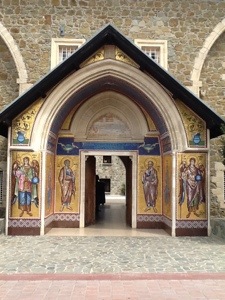
When we arrived at the Kykkos monastery, there weren’t that many people, which was perfect. The monastery lies at an altitude of 1318 meters on the north west face of Troödos Mountains. This is not a favorite place of all Cypriots because its a wealthy monastery and people feel the money should have been spent on the poor people. But it was beautiful; there were many mosaics and murals on every floor. There was a grand belfry on the hill that had 5 bells, but we didn’t hear them. The story of this monastery drew our attention. We read about it in the museum. Where I took a few illegal.
According to tradition, a virtuous hermit was living in a cave on the mountain of Kykkos. One day, the Byzantine governor of the island, doux Manuel Boutoumites, who was spending the summer at a village of Marathasa because of the heat of the season, went into the forest to hunt. Having lost his way in the forest he met this hermit and asked him to show him the way. The hermit who was not interested in the things of this world would not answer his questions. Boutoumites got angry, called him names and even maltreated him. Not long after, when he returned to Nicosia, he fell ill with an incurable illness. In his terrible condition he remembered how inhumanly he treated the hermit and asked God to cure him so he could ask the hermit for forgiveness. God appeared to the hermit and revealed to him what had been planned by the divine will and advised him to ask Boutoumites to bring the icon of the Virgin, that had been painted by the Apostle Luke, to Cyprus.The icon was kept in the imperial palace at Constantinople. When Boutoumites heard the hermit’s wish he was taken aback because he considered this impossible. The hermit explained to him that it was a divine wish and they agreed to travel together to Constantinople for the realization of their aim. Boutoumites could not find the right opportunity to talk to the emperor and ask for the icon. So he provided the hermit with other icons placating him that he would soon see the emperor. The daughter of the emperor had fallen ill with the same illness that had struck Boutoumites; he grasped the opportunity and went to see the Emperor. He recounted the story and assured him that his daughter would be cured if he sent the holy icon of the Virgin to Cyprus. In his desperation the emperor, seeing that he had no other option, agreed. His daughter became well instantly. The emperor, however, not wanting to part with the icon, called a first-class painter to make an exact copy to send to Cyprus. That evening, the Mother Mary appeared in a the emperor’s dream and tells him to send the original to Cyprus and for the him to keep the copy. On the following day the royal boat with the icon of the Virgin departed for Cyprus. During the procession of the icon from the coast to the Troödos Mountains, according to legend, the trees, participating in the welcoming ceremonies, were piously bending their trunks and branches. With patronage provided by the emperor Alexios Komnenos a church and monastery were built at Kykkos, where the icon of the Virgin was deposited.
George bought a Saint George icon, I was happy with my photos. In the souvenir shops outside, they had George’s olive oil, but we didn’t get anything. I did see a fun ring but it was too expensive.
We then drove through Troodos, and a few other towns on our way back to Lemesos. We unpacked the car and within 15 minutes hopped right back into it to go shopping. Now we ended up, doing more walking around because the stores close early on Saturdays. We parked near where Carol’s uncle used to live, right next to a huge church. George found two icon stores, Wendy bought some postcards, and I bought soap. Ive been trying to find this liquor called Mastipho by Krinos, but am not having a lot of luck. There was this cute gallery near the car called Cheap Art, and some of the art was quite fun. Nothing had prices on it, and were didn’t realize the name, or we might have bought something…but there’s still time.
Tonight we ate dinner with Michael, Nathalia, Vera and Ricos at a Greek mezzanine style restaurant nearby. We didn’t eat a full lunch, so we prepared our stomachs for tonight. It was a meze menu and OMG I’ve never seen or eaten so much food. If you want to check out the menu go to Shiambelos. I swear we ate everything on the menu. We counted and there were 20 plates of food. The food just kept coming and coming. Delicious but too much. Vera took a bag of meat weighing about 5 pounds back to her cats.
 Traveljunkies
By any chance did you manage to attend a Greek Orthodox service?
No we didn’t. The prayers for Iris were conducted by a Greek Orthodox priest. That’s the closest I got so far.