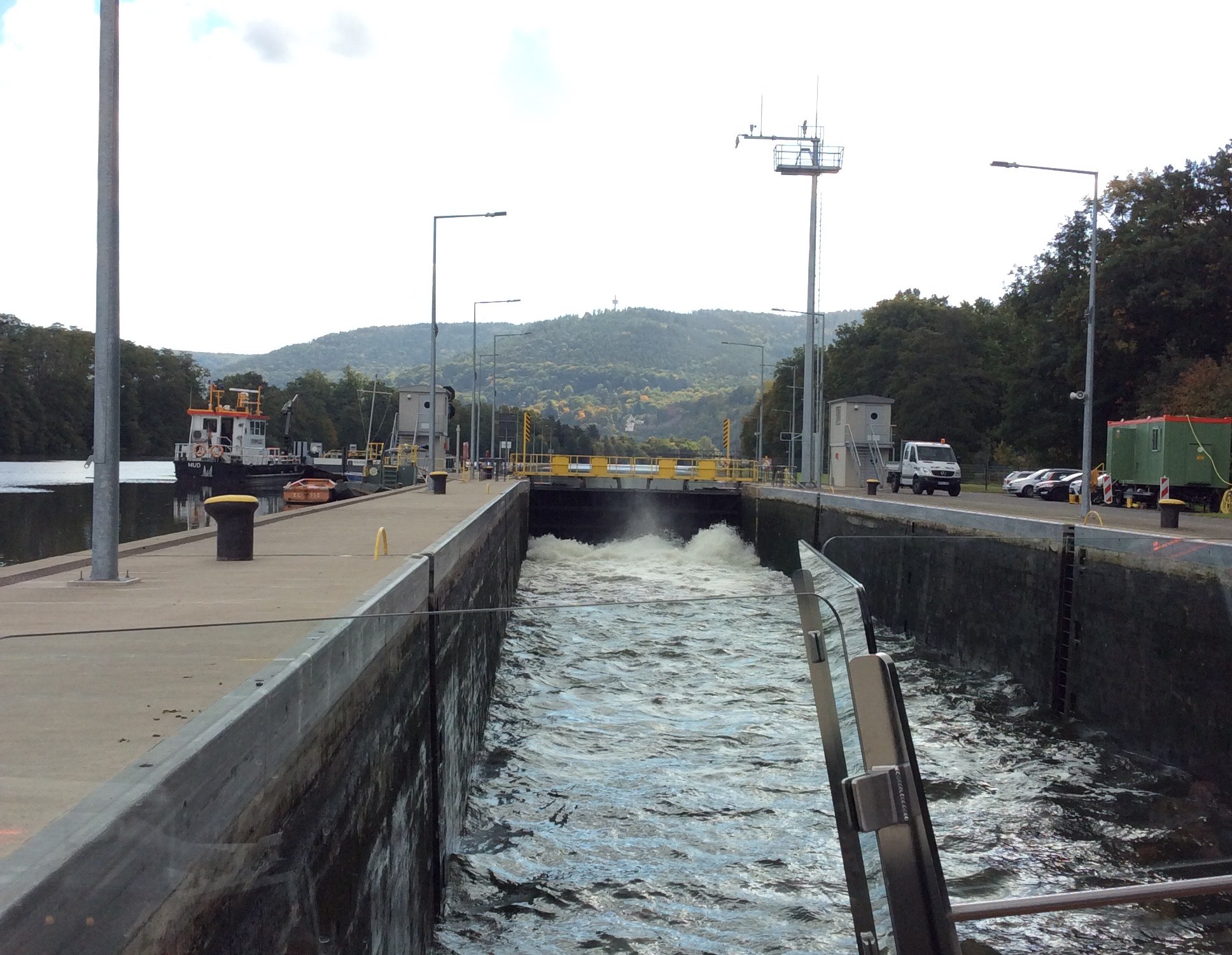
Today was spent cruising down the Mainz. We entered multiple locks, last night and throughout the day. One way to know you’ve entered a lock is when you’re asleep is the small bumping against the sides of the lock. There’s not a lot of room between our boat and the sides. I touched the inside of the lock, and when we rose, at the point our balcony was level with land, I touched land. I’m sure to most people around here it’s an every day experience, but I think it’s quite cool.
The countryside along our cruise is beautiful. The hills are lined with vineyards, some of which appear to be on steps up the side of the hill. We could see multiple farmers harvesting the grapes, but in a photo they look like ants. I sat at the front of the boat in the sun for a while and it was prime seating here. It was quite warm in the sun, but seeing us enter a lock from the front, watching the gallons and gallons of water fill the lock doesn’t quite even describe the experience. Some people on the ship had their binoculars and were bird watching. The next site we’re supposed to see is at kilometer 121 a Kleinheubach Castle which is the home of Princess Lowenstein and was modeled after Versailles. We realized later that we never saw it.
There was a talk this morning about the canals. Bowman took notes while I sat in the sun at the bow of the boat. Canal boats are the oldest & first form of transportation. The 1st canals was built in Egypt 2000 BC; the most extensive canals started in 600 BC in China; Romans built navigable canals starting in120 AD. England was first country with a national network of canals. The Industrial revolution was made possible by transportation of goods by canals. Americas founding fathers believed canals were key to success and developed the Erie Canal, Illinois and Michigan canals. Canals inspired the first tunnels and served as a model for railway system. After 1840 smaller canals were used mostly for recreation and large canals for global trade. The first locks were built in 50 BC in China. 10th century AD “pound lock” created – that’s what we used today on our Viking cruise. 1st one in Europe was in Netherlands in 1373. Leonardo Divinci created the mitre lock in 1487 with a V shape.
We will go throu 62 locks in total. The 82 feet high locks we’ll experience near Nuremberg is our tallest. Our staircase lock costs about $1000 euros on the Mainz, but the Danube locks are free. In Vienna one nights docking fee is $1000 euros. The Danube actually travels through 10 countries. Between Bamberg and Kelheim we have 15 locks lifting 243 feet. 13 of 16 locks on Rhine main Danube are Eco-locks which use 60% less water.
We arrived in Miltenberg earlier than originally scheduled. Our tour didn’t start until 2:30, but almost everyone was ready to get off the boat. They went to the newer part of town, but mom and I stayed on the ship.
During our tour we learned about the history of this old Germwn city built in the 1200s and the population is only 9000. Tourism helps to keep the town up and running. We learned about the different sections of the city and where the oldest part was. There were beautiful shops, bakeries, sweets, brauhauses, and of course a church, castle and square with a fountain. The fountain has some fun history, there are cherubs at the top and one is mooning the mayor of the town. The artist was mad at him for something and did that on purpose.
We strolled around the town, shopped, had a soft pretzel, and mom had to use the WC. So the lady in the bakery let her use theirs. But mom ended up locking herself in the bathroom. I was wondering what was taking her so long. Eventually she came out about 15 minutes later, after a man and woman helped her unlock the door. She was shouting for help, in the dark because the electricity went out, fortunately so one heard her.lesson learned – check on your mother after 10 minutes if she hasn’t returned.
The Hotel Zum Reisen was my favorite building because of the paintings on the front of the building. It’s probably one of the most photographed buildings in Miltenberg. And it’s still a working pub. Other fun sites included pub signed, a wine store that was also a cave (mom bought a bottle of Reisling). Bowman liked the original city wall built by the Romans, and she took some beautiful photos of doors.the bridge that connects the older and newer part of Miltenberg was destroyed by the town during WWII, preventatively to protect the town from the Americans, wanting to keep them out. Funny thing was the Americans were already there. We brought things like stockings and other things, and the people in the town didn’t think we we’re that bad.
We all met to head to the boat at 5:45 and had to take buses to our ship in a neighboring town. It moved to Werthheim. Before meeting up with the group mom and I met up with John and Bowman who were at a Turkish Vietnamese restaurant having wine and spring rolls. Weird but true.
 Traveljunkies
Jacqui, loved your history lesson on canals! Very informative. If you’re really into locks, you, your mom and traveling companions should consider renting a canal boat in England or Wales. It’s fun to work the locks.