We left the lodge in two vans this morning for Khao Sok National Park. This was an optional full day trip, that cost 1500 baht, but after hearing a little about it, we didn’t want to miss it. We took two vans, and the drive was about an hour. Our driver took us on a back road to show us the acres of rubber tree and palm trees. We stopped at a small farm and Amy asked the owner if he would tell us about his rubber trees. She’d never been there before, but he was happy to show us around. He had 4 acres of trees and they were spaced evenly out for optimal growth. The trees will not produce the rubber until they are 7-8 years old and then will produce until 30 years old. To get the rubber from the tree, he takes a knife and slices off a small piece of bark, on a diagonal, so the white saplike goo runs into a pot. It will take 3 days for the cut piece to dry up. Then he takes the juice, and mixes it with a chemical and water to harden it and puts it through a ringer to press out the water. Next they bring the rubber sheets to dry for three days outside and then they hang them inside because of the humidity before selling them. He told us that rubber is currently going for 43 baht a kilo, and each pad is about 1.5 kilos. He can farm ten of twelve months a year because in April and May the trees lose all their leaves.
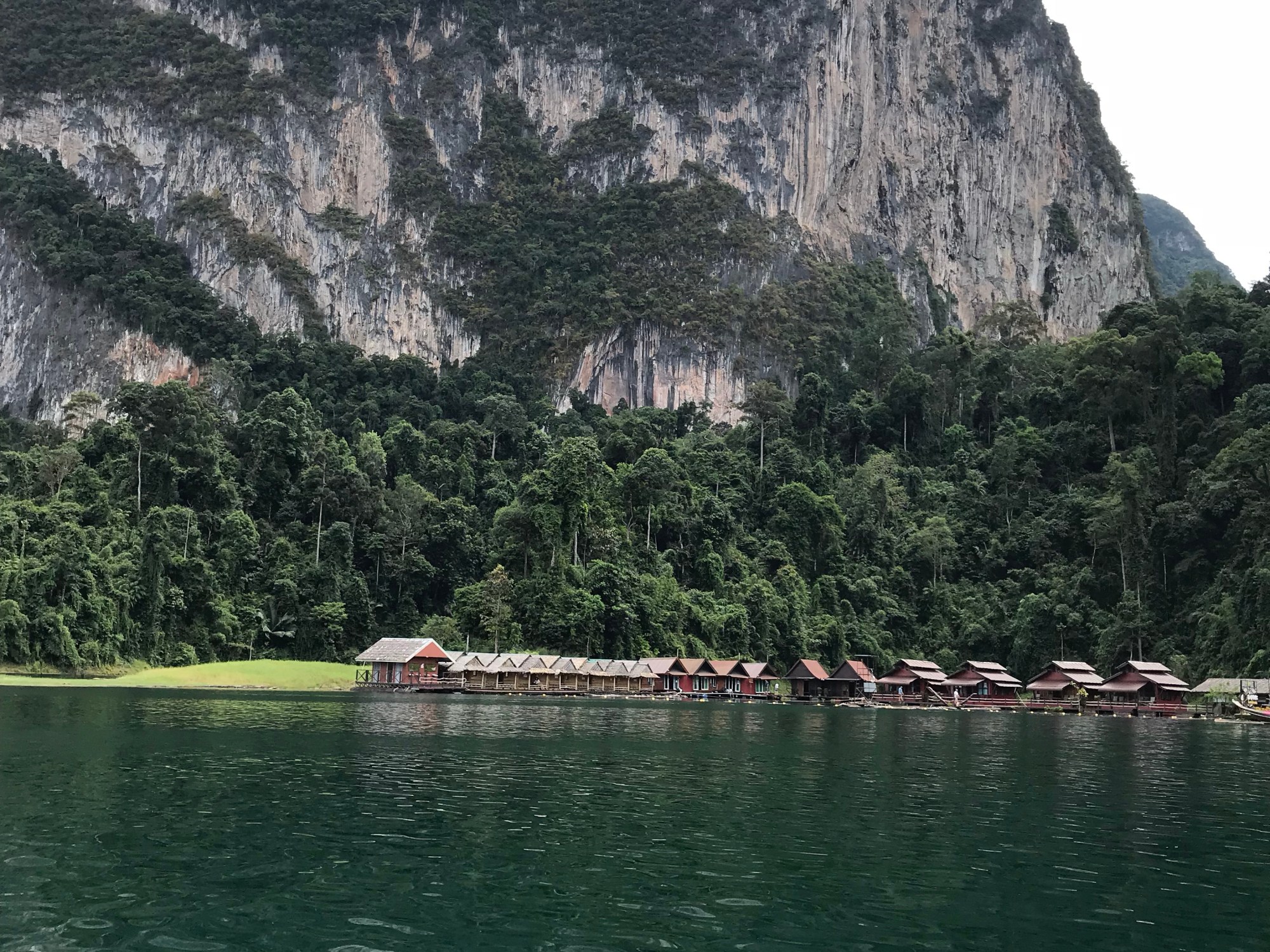
We continued on to the park, where we boarded two longtail boats for Khlong Ka Raft House which was an hour away. This Cheow Lan Lake was created in 1982 when they built the Ratchaprapa dam and flooded 385 families of the Ban Cheow Lan village. Our longtail captain used to live in one of the underwater towns that was resettled. Each family received 19 rai (7.2 acres) of rubber plantation as well as one rai (0.39 acres) for their private homes. As part of the compensation, the resettled people received 1,000 baht monthly per family. Resettlement drove the creation of basic public infrastructure, water supply systems, and public buildings such as schools, police station, medical center, and community hall which were built by the Thai government.
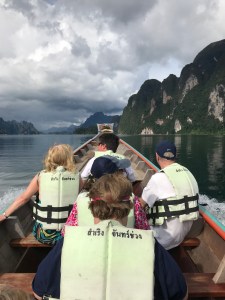
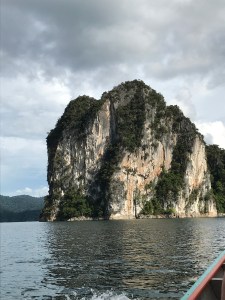
During the boat ride, we couldn’t take our eyes off of the spectacular limestone cliffs and evergreen rain forest jungle. The national park area is inhabited by a large range of mammals such as tigers, elephants, tapirs and many monkey species. Birds such as hornbills, banded pittas and great argus. Less commonly seen reptiles include the king cobra, reticulated python, and flying lizards. We did not see any interesting animals, and while I would have loved to see a gibbon, I was quite happy not to run into a cobra.
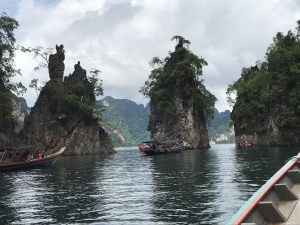
Mark got to drive our boat in the section where the Three Friends were located. Our captain’s village was right below this.
Around the reservoir 17 different “floating bungalows” accommodate tourists. Only descendants of original inhabitants of Cheow Lan village and officials of the national park are allowed licenses to own and operate these bungalows.
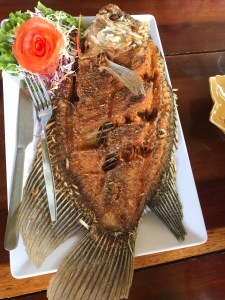
At the resort, we changed into our bathing suits, most of the group set out on kayaks, while Erika and Matt headed for the swimming area. To get in the water you either had to jump off the dock, or walk across a huge tree that was tied to the dock. It was slippery in spots and not flat, so you had to walk slowly. The water was warm, but not hot. I expected it to be cooler based on the teal color of the fresh water that came from 7 rivers that fed the reserviour. A bunch of us went swimming after lunch, and it was also surprising how clear the water was. For lunch we had stir fried vegetables, omelette, green curry, rice and elephant ear fish. I’m sure this fish has another name, but I have no clue what it is. Andrew and I had fun picking the meat off of the fish, even if it was a little dry.
At 3pm we had to leave paradise and head back to our hotel in the rain forrest. We were quite fortunate to have such amazing weather today. On the way back we stopped at a local market. Amy showed us some of the local foods, and we tasted fried banana, tapioca in a banana leaf, rose apple, corn fritters, and rice paper crepe with nuts. She told us a story about how her grandmother used to chew on beetle bogs like fruit that turned her teeth black, because at the time it was in style.
When we got closer to our lodge, it of course was raining.
Bowman reports that over a relaxed dinner, everyone jumped on the WiFi to catch up with the world; and check out our next destination. We looked like a bunch of teenagers – all sitting together but everyone on their device of choice. Tomorrow morning we are off to a Krabi.



 Traveljunkies