We arrived in Tauranga before 8am this morning to a beautiful sunrise. The city is nestled in the Bay of Plenty. It’s called that because James Cook saw how green and fertile it was, he named it that. It’s watched over by Mt. Maunganui, an extinct volcano that helped shape the region. The Maori arrived here in the 13th century followed by the British 600 years later.
We grabbed a quick breakfast before heading on our excursion. Carol, George, Nancy, John and Sue were on the same tour. Today we went to Te Puia, in Rotorua, a center for the Maori culture and geothermal wonderland. It took us about 1.25 hours to drive there and we learned a lot about the area on the way. Here are a few fun facts:
- 2 different kinds of kiwis are grown here – green and gold. New Zealand is the third largest producer of the fruit (after China and Italy). It’s only harvested once a year between April and May. They grow 125 million trays of green and 160 trays of gold kiwi. What I didn’t know is that it grows on a vine. At first I thought they were vineyards.
- There are 18 volcanic lakes in Rotorua. Some are quite deep, but the main one Lake Rotorua is only 10 meters deep.
- 8 edible tree nuts are grown in NZ
- The two main industries in this area are tourism and forestry
Just before arriving at Te Puia, we learned the Maori greeting for hello – Kia Ora. During our visit we did the following:
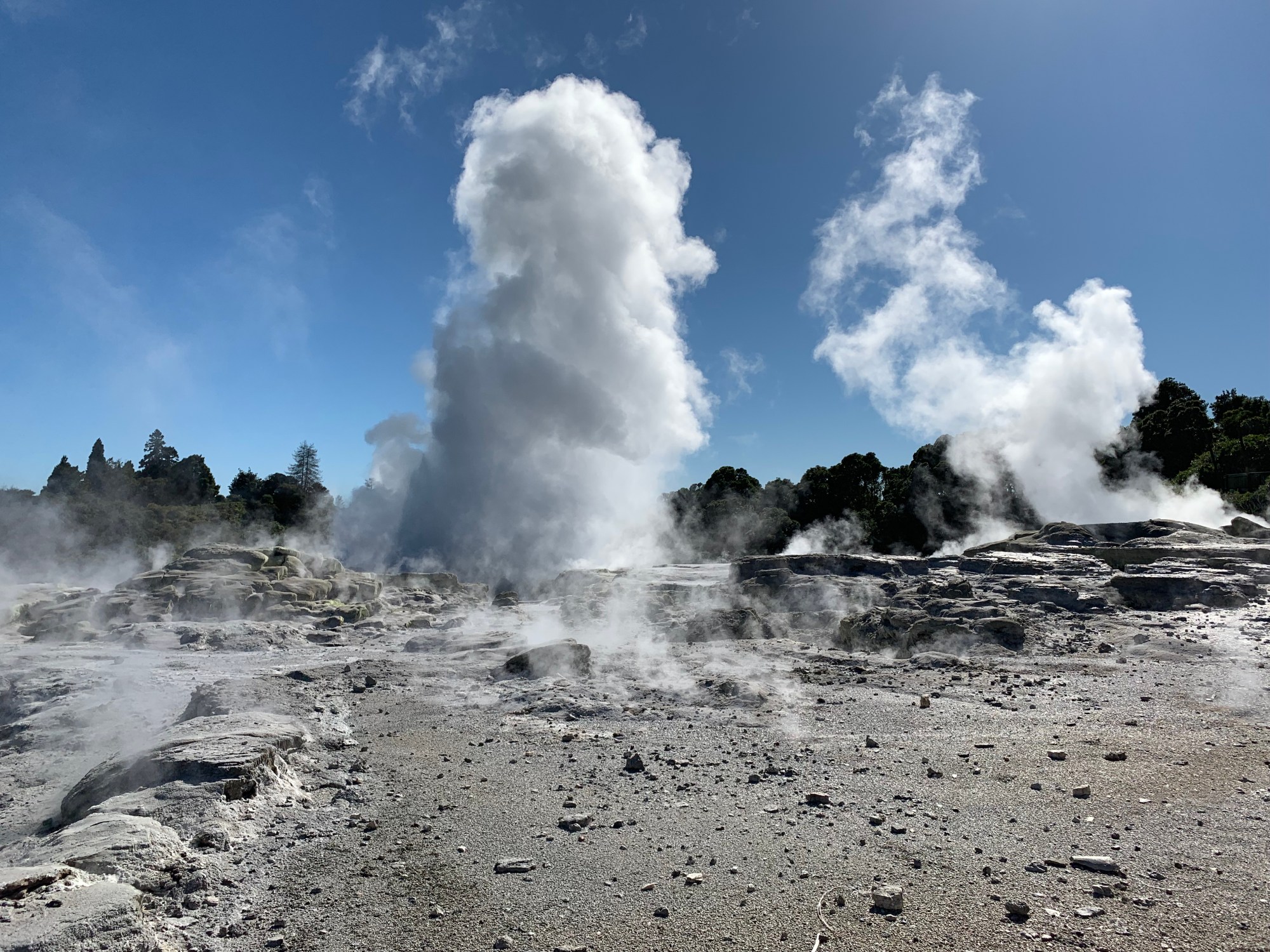
- Geothermal activity – Pohutu Geyser is a very unreliable geyser despite what the website says. It’s the largest active geyser in the Southern Hemisphere. It reaches heights up to 100 feet. For hundreds of years, the many geothermal hot pools in Te Whakarewarewa Valley have been used for cooking, washing, bathing and preparing flax. This cooking pool is named after the tuatara, an ancient lizard-like reptile only found in New Zealand. As we got closer we could smell the sulfur. The water temperature is around), white deposits around the g
- Mud pools – are an icon of New Zealand scenery. They form where steam and gas rise to the surface under rainwater ponds. The acidic gases attack surface rocks, forming clay. The clay-rich soil mixes with the pond water to produce a muddy, steam-heated slurry, or mud pool. Supposedly wonderful for arthritis.
- Traditional Maori welcoming ceremony and cultural performance. The “wero” started with a Maori warrior approaching and challenging our designated chief Larry. This was done to ensure visitors come in peace. Larry was presented with a fern leaf followed by a “powhiri” welcoming ceremony which included entering the Marae building, touching noses twice with each warrior. The cultural performance included singing, women dancing with the poi, men dancing with sticks. It was very good.
- Kiwi – we attempted to see two kiwi birds, but they were sleeping. They are nocturnal and sleep 22 hours a day. That have long beaks, don’t fly, and are becoming endangered with the population shrinking.
- Lunch and gift shop – there was not enough time for either of these
Our driver took us by the lake on our way home. But it wasn’t the lake that was most interesting it was the thermal hot spots that existed in some of the parks. One was Rainbow Park. A few years ago enough pressure built up in one them and it shot boulders across the street at the hospital. It was odd to see steam coming out of areas where grass and trees are located. The Tudor style Rotorua museum used to be a bath, but was converted into a museum. Unfortunately it’s closed and not safe, primarily because of the amount of seismic activity weakening its foundation. I decided that I wanted to come back and experience the hot springs, and mud pools to their fullest. Maybe Viking should include that as an excursion.
Tonight we’re going to dinner with mom and Ruth at the Manfriedo Italian restaurant. I’m hoping to sit in a hot tub and just relax. Tomorrow is Napier.
 Traveljunkies
Pix of sensational sunrises and sunsets would be nice too !
Thanks. Having some problems posting photos with spotty WiFi. We had a gorgeous sunset last night.