Melbourne is the capital city for Victoria, and has been called the most livable city. It’s the second largest city in Australia with a population of 5 million. There are 6.5 million in all of Victoria. It’s a young city built in 1835.
Ruth, MyLisa and I went on a private tour of the Great Ocean Road. It wasn’t offered by Viking, so we found one that met our needs at a reasonable price. Our tour guide Neil, self-proclaimed Bushie (lives in the country), has been doing tours for 24 years. This 12 hour tour enabled us to experience the beauty of Victoria by seeing the diverse landscape of the city, coast, country seeing indigenous trees, wildlife, art and towns. The windy road reminded me of the Amalfi coast, or Road to Hana. It is 180 miles long and was built by veterans It included stops at the following places:
- Chocolate tasting at the Great Ocean Road Chocolate Chocolatier our first stop after starting the road. We arrived just in time for a 15 min info/tasting session that was being photographed. We tasted 15 chocolates, some with unique Australian flavors – eucalyptus, jindilli nuts, billabong anise, roasted waffleseed, gum tree
- Anglesea Golf Course – we were a tad confused and skeptical when Neil pulled into a golf course asking us if we wanted to see kangaroos, because they love golf courses. We ended up seeing two – a mom and her joey. They do kangaroo tours, but we saw these on the side of the road.
- Split Point Lighthouse – we only stopped to take photos. Built in 1891, it’s located on the Aireys Inlet to help guide ships along Shipwreck Coast. Over 50 shipwrecks were commemorated along the the road – streams, gorges, rock formations all named after shipwrecks
- Great Ocean Road Memorial Arch – This landmark marks the geographic border between the great Pacific and Indian oceans. This point is located at the Split Point Lighthouse which you will pass before the stop to take some memorable pictures in front of the memorial arch.
- Lorne Beach is a popular surfing spot. We didn’t stop, but this town like others had such a beautiful coastline where the brilliant blues of the ocean met with white waves and black lava rocks – all breathtaking.
- Kennett River – we stopped at this unusual spot on the road that had a sketchy restaurant. Neil asked us if we wanted to feed some birds, and we said sure. He filled his pocket with bird seed as we walked over to a spot with trees, ducks and tourists. At first I was disappointed in feeding ducks, but there were about 6 green parrots that if you put birdseed in your hand, they would sit on your hand. We all got to hold the birds. But that wasn’t all. There were also two koalas in the trees right where the parrots were. It took us a bit to find them, but the trick is to follow the cameras. Even though there are 850 types of eucalyptus trees, koalas don’t eat all of them. Koalas are not good conservationist; they tend to eat all of the leaves off of a tree, then killing the trees.
- Apollo Bay Seafood Cafe – we stopped for a seafood lunch in Apollo Bay. Neil, recommended this restaurant, but he is not a seafood lover. That said, we ordered King George whitefish and chips, and it was quite good. Poor Ruth wasn’t feeling well and decided to stay in the car.
- Marengo beach – we stopped here briefly so I could pick up some local sand at this beach. Theres a rock formation about 150 meters off the beach, where a colony of seals sunbathing. The Bay is protected by Hayley reef 50 meters off the shore. There are supposed to be up to 200 seals. Fortunately I had a zoom lens, but they still look small. Some brave souls people kayak there to see the seals. It is a protected marine sanctuary.
- Otway National Park and Rainforest – we left the coast for a bit to drive northwest through the Otway park. This is the wettest part of Victoria getting 2 meters of rain a year. We decided not to stop for a walk, but continue through to the 12 Apostles. We had a glimpse at the striking centuries-old, colossal eucalyptus and fern trees. We attempted spotting koalas in the trees. Neil found a few, but we struggled. I believe I saw one, but can’t prove it.
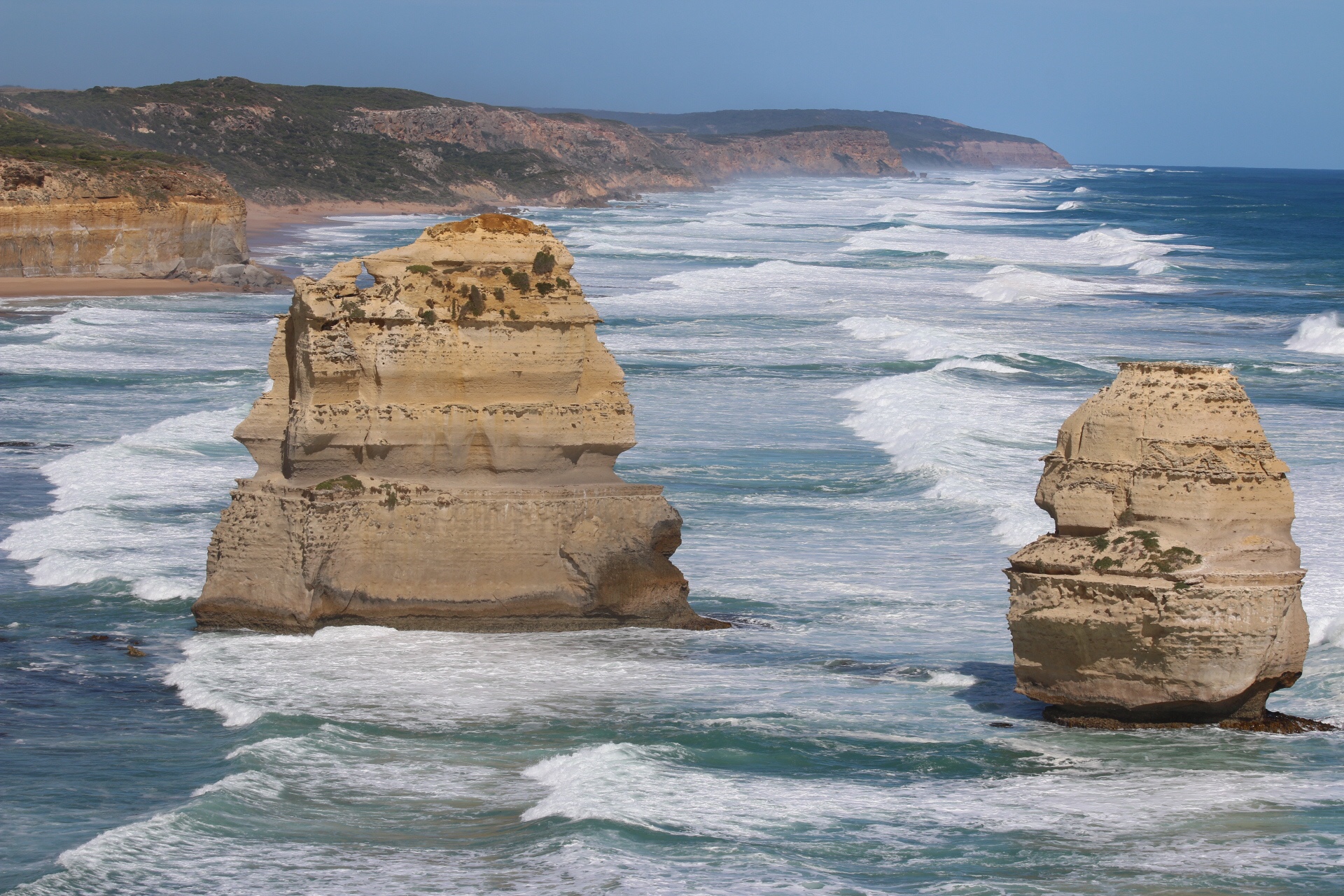
- 12 Apostles – this is what we were waiting for. Poor Ruth didn’t feel well enough to make the walk, but we went on without her. Neil warned us not to count the apostles or we’d be disappointment. These iconic golden cliffs were spectacular. Technically there are only 7 stacks. The wild and powerful waves of the Southern Ocean constantly pounds the coastline which has shaped the area and limestone stacks. In 2005, one stack collapsed and its expected that due to the wave action eroding at the base that new stocks will reform in the future.
- Kangaroos in a wild – after passing through the rain forrest, we entered the countryside again, Neil pulled onto a dirt road and we wondered where he was going. In the field we say about 20 kangaroos. There was a very tall female standing upright who didn’t take her eyes off of us. In the same area we saw a black cockatoo in a tree.
- Gibson Steps – we did not walk down the 86 steps, carved out of the cliff but you take them down to the beach. You can see two rock formations, Gog and Magog, which are not part of the 12 Apostles.
- Loch Ard Gorge – the gorge was beautiful, and the story about the two survivors also quite interesting. The gorge was named after the ship that wrecked in 1878. Of the 54 passengers and crew only Tom Pierce and Eva Carmichael, both 19, survived. Tom scaled the cliff walked through the dense brush, eventually ran into people who organized the rescue of Eva.
- London Bridge – this beautiful arch was once two arches. In 1990 a man and woman were on the far arch when the first arch, collapsed unexpectedly leaving them stranded. They had to be helicoptered off the. Rumor is that he a married man was with his mistress, but we don’t know for sure.
- Port Campbell
- Return to Melbourne – we took a completely different route home through the countryside, small towns and eventually Route 1. Some of the interesting sites included miles of stone wall with out mortar, pink galahs, fresh water crater lake, hundreds of corella birds in the trees. It was a lovely ride. Route 1 is 10,000 long and goes around the entire coast of Australia. Might take 2 months to drive it all though.
We did not see any of the carnivorous cousin of the koala, the drop bear. The bear drops from trees and eats tourists. Gullible tourists and even some locals have fallen victim to looking and watching out for this mythical creature.
Mom, George, Carol, Sharon, Nancy, John, Sue, Alton, and Candy went on a private tour, that visited 2 state parks, one for kangaroos and the other for koalas, both only 45 minutes from Melbourne. Martin was an awesome guide. The first stop was koalas. It was hard to see them in the trees, and easier with binoculars. The group,saw 3 or 4 and watched a few off them move and climb on the branches. At the kangaroo park, they saw 20+ kangaroos far away, and they were afraid they wouldn’t see any of them close enough. But Martin walked them to another spot much closer. Unlike the sanctuary in Tasmania, these were wild and not fed or touched. When the female has the baby, it stays in the pouch for almost a year, and then suckled until it’s almost 2 years old. During that time she can get pregnant again, but the baby doesn’t grow until the Joey is out of her pouch.
They had a lovely picnic lunch accompanied by Billie tea. Martin made it on the spot using eucalyptus and some sort of nut, with hot water. He swirled it around 9 times in the air, more makes his arm hurt. Everyone said itwas quite tasty.
Check out photos here
 Traveljunkies