We learned last night that we’ll have to change boats in Nuremberg on Sunday. Two other ships attempted to make it through, and unfortunately had to turn around. There hasn’t been enough rain, so the river is too low to pass. Tonight we pack up our clothes, and luggage, and after we get off the boat to tour the city, we will be swapping boats with another Viking ship south of us. A few of the crew follows us, but not many. We’ll have to take a bus to the new boat, and I think it might be 3 hours away. We’re disappointed, but what can you do.
Today we toured Bamberg, in 1007, Bamberg was the center of the Holy Roman Empire. It’s built on 7 hills and each has a church on top of it. The city has always been linked to the river, and is the starting point of the Main Danube canal. In the 17th century the city held witch trials where both men and women were burned at the stake. It is one of the few medieval cities not destroyed during WWII and is a UNESCO World Heritage site.
Since we didn’t arrive in Bamberg until 1:30, we had a glass blower come onboard today for a demonstration. His name is Karl Ittig, and he’s a 6th generation glass blower. Nine months out of the year he lives in Wertheim, Germany, and his one-of-a-kind work is represented by Bon-apart. But his family also founded a Eugene School of Glass in Oregon, so he frequents the US a lot. Three months out of the year he’s in Seattle working for team Chihuly. He met Dale Chihuly in the 60s when he was a glass blower. Karl helped with the Jerusalem exhibit. Check out the photos online. He was quite fun to watch. We learned about the class, the blowing process, and I volunteered to,have a shot of Jagermeister with him. Little did I know I was going to be part of the act. I actually got to blow glass with him, and he gave me a beautiful glass ornament that we made together. It was really cool. My travel companions were surprised when I volunteered, thinking I just didn’t drink. All of us ended up buying some of his work…they were all beautiful. And with every purchase, we got a free glass candy.
At 1:30, we headed into Bamberg. I’m finding myself more partial to the smaller cities. Bamberg has a population of 70,000 and while in some ways felt small, it was not as quaint. We split up this trip – girls and boys. The guys want on a beer tasting tour and we went on the regular tour. Our guide, Ben (don’t call him Benjamin) took us to the green market, where there was a statue of Neptune or Poseidon, or as the German’s say, the man with the pitch fork. There was produce for sale and other items. We walked through the city, and over a bridge where we saw the town hall, which had a magnificent fresco on the outside of the building and a view of houses along the river. Thee were three sections in Bamberg, the center, which was the island, and mainland, which was northern, and the southern part. We spent most of our time on the island.
We walked past the famous smoked beer brew brewery in the middle of the old part of Bamberg, called Schlenkerla. First mentioned in 1405, they still have it on tap and in German it’s called Rauchbier. John liked it, but of the three beers they tasted, the guys seemed to like the lager most. It’s a dark, aromatic, bottom fermented beer with its smoky flavor is being achieved by exposing the malt to the intense, aromatic smoke of burning beech-wood logs at the malting. After mixing it with premium-class hops in the brew, it matures in 600 year old cellars, deep down in the hills of Bamberg, into a mellow, magnificent-tasting beer, best drunk directly in the pub. Or that’s what they say.
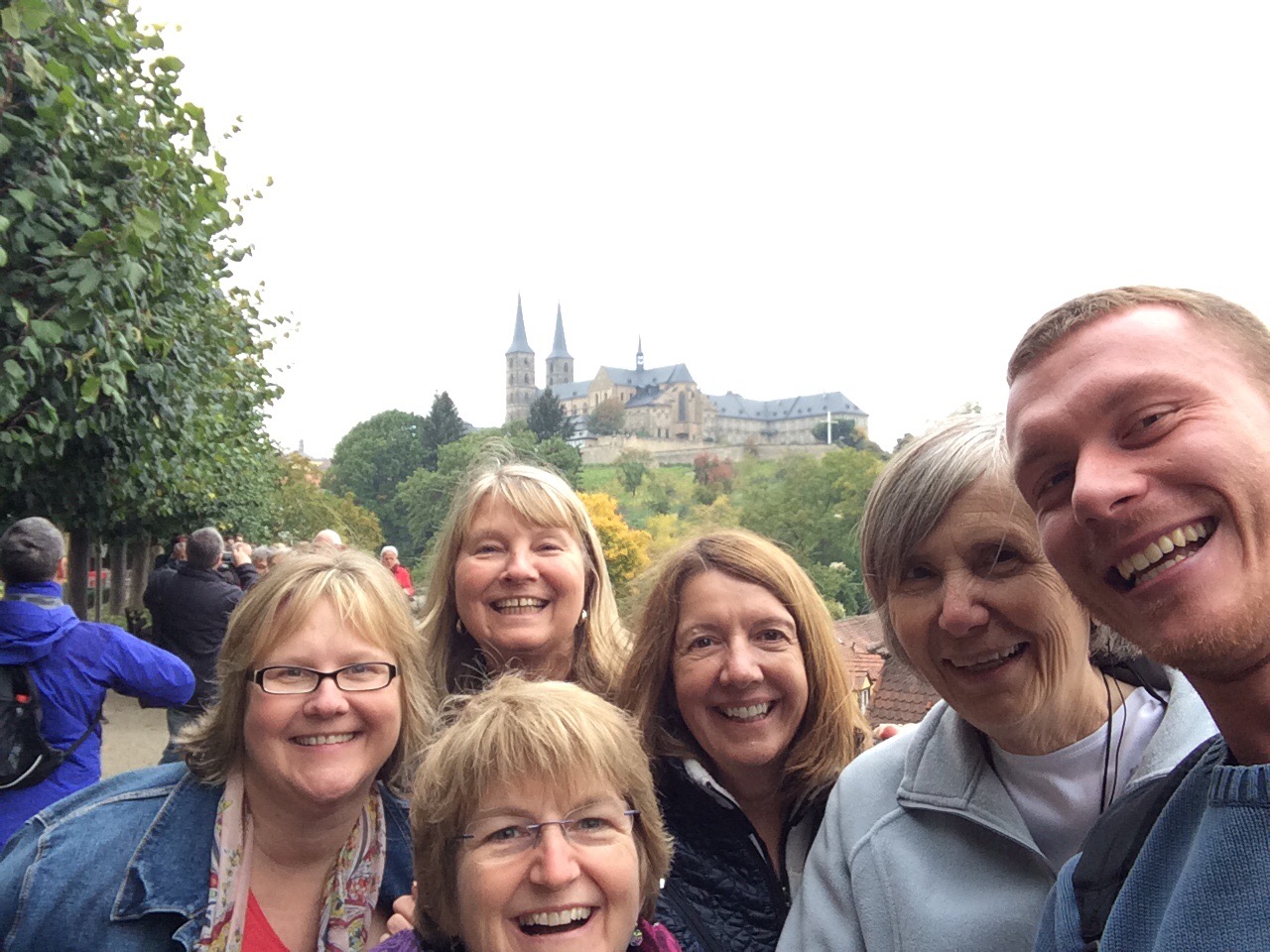
We walked to the Bamberg Cathedral, where the bishop used to live and also saw the newer bishops residence. The cathedral is a late Romanesque building with four imposing towers. It was built, then destroyed by a fire, rebuilt, then burnt down again, and rebuilt one more time. The residence was interesting, and beautiful red and white flowers hanging off the balcony. Then we walked over to the palace rose garden, and many of the flowers were still blooming. From the garden there was a magnificent view of the working monastery on the neighboring hill.
We walked back to the green market afterwards shopping on the way and stopping for some coffee, tea and chai to warm us up. This was the coldest day we’ve experienced so far. It was in the low 50s. I forgot to mention this earlier, but throughout the city were these stumbling stones. They were the shape of a cobblestone, but instead are a bronze plaque with a person’s name. They are to commemorate the victims and survivors of the Nazi oppression. The stone is a little bit higher than the other cobblestones, so there’s a chance you might trip on it, look back and remember. This type of monument was created by artist Gunter Demnig, and there are now over 48,000 stolpersteins have been laid in 18 countries in Europe, making the project the world’s largest memorial.
We all met up at 5:30 to head back to the ship. The crew gave us a warm welcome when we arrived. Tonight after dinner we pack. Booooooo

